Japanese suicide culture
You Only Live TwiceJapanese suicide culture, as discussed by Tiger Tanaka and James Bond, is not treated as a single motive or custom but as a contested way of assigning meaning to death. Tiger describes suicide as a possible expiation for dishonour and a source of restored standing; Bond sees the same ideal as a waste of life and a dangerous devaluation of other people. Their argument acquires immediate significance when Tiger connects these competing interpretations to the crowds drawn to Dr Guntram Shatterhand’s poison garden, a place where self-destruction has become both a public spectacle and a practical crisis.
Honour, failure, and competing judgments
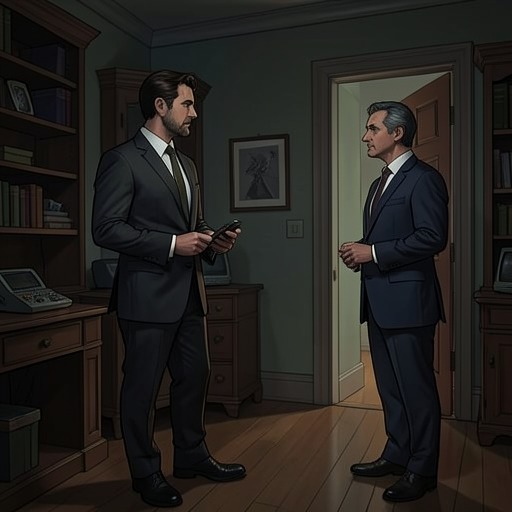
Tiger introduces the subject through a report in the evening edition of the Asahi: an eighteen-year-old student who had failed a university examination for the second time. Living in Tokyo’s suburbs, the student went to a nearby department-store construction site and placed his head beneath the block of a working pile-driver. Tiger explains the death as an attempt to expiate the dishonour brought upon the student’s parents and ancestors. He suggests that, in the neighbourhood’s eyes, the act could restore face to both the dead student and his family.
Bond rejects that interpretation. In his view, the student had other options, such as taking a lower-level examination or entering a less prestigious college; failure should lead to readjusted ambitions, not suicide. Bond argues that killing oneself would be understood in Britain as an evasion of life’s reverses and a source of pain to one’s parents, not as an honourable act. Tiger counters that his country has not become so thoroughly demokorasu: among those he calls old-fashioned, dishonour must be expunged, and giving one’s life can be understood as the most complete possible apology. In this exchange, the dispute is not simply over whether a death is tragic. It is over who has the authority to interpret it—the individual, the family, the community, or an outside observer—and whether social recognition can transform personal destruction into sacrifice.
The two men also disagree about the social consequences of treating life as expendable. Bond calls the student’s death a waste and links the practice to what he sees as a broader streak of violence in Japanese history. He recalls a multiple traffic accident in which police, he says, made the injured remain where they lay so that bodies could be outlined in chalk and photographed for a court case, rather than concentrating on getting them to hospital. Tiger replies that this procedure is common and invokes overpopulation and legal abortion as part of the context in which deaths are understood. The conversation therefore places an individual act beside public institutions and social pressures, although the novel gives these claims as opposing characters’ interpretations rather than as neutral sociological findings.
Stories, ritual, and public examples
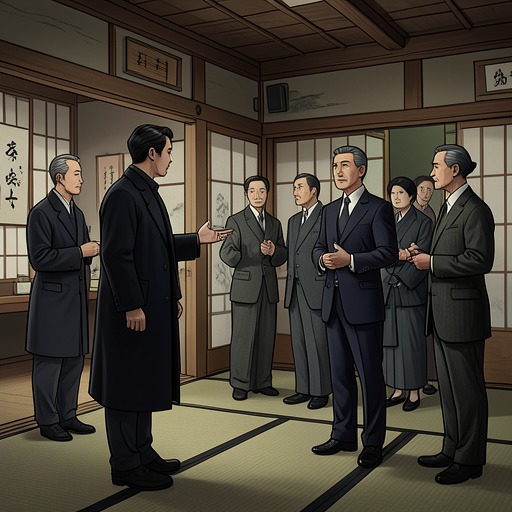
Tiger acknowledges the violence of suicide while insisting that jisatsu carries no stigma in the way Bond expects it to. He points to the story of the Forty-Seven Ronin: after their negligence led to their lord Asano’s assassination, the retainers swore to avenge him, accomplished that revenge, and then gathered at Ako to commit seppuku in expiation for their failure. Bond refers to the practice as hara-kiri, which Tiger dismisses as a vulgar expression. The story’s continued public remembrance is made visible in special trains laid on for pilgrims attending the festival at the Ako shrine. In Tiger’s account, inherited stories and commemorative practices make self-sacrifice intelligible to successive generations; Bond responds that teaching children to venerate such acts helps sustain their appeal.
Tiger makes the public scale of the phenomenon explicit with his estimate that 25,000 Japanese people die by suicide each year, adding that bureaucrats are the ones who regard the figure as shameful. He describes spectacular attempts that attract renown, lovers who leap together at Kegon Falls in Nikko, and people who run down the burning slope of the crater on Oshima into its bubbling centre. Authorities, he says, have opened an expensive Suicide Prevention Office on the volcano’s peak. He contrasts this intervention with the railway, whose self-operating trains offer what he calls a convenient means of death: the stark comparison makes visible the distance between official efforts to prevent suicide and the persistent attraction of familiar, accessible methods.
The poison garden as a destination
The debate turns from cultural explanation to the plot’s immediate danger when Tiger says that Shatterhand’s poison garden has become Japan’s most desirable destination for people seeking death. He describes the journey as an itinerary: a ride on the Romance express to Kyoto, a boat across the Inland Sea, a local train from Beppu to Fukuoka, and then travel along the coast to the ramparts of Death Castle. Visitors may climb over the walls or enter on a provisions cart before walking through the grounds. Tiger’s account makes the journey’s beauty part of its menace: a deliberate, almost ceremonial passage ends in a choice among lethal plants, animals, and volcanic features.
The garden’s dangers are presented as a macabre game of chance. A Russell’s viper may strike; poisonous dew may fall on someone resting beneath a tree; berries or fruit may invite a curious visitor to eat them; or a fumarole may kill in a brief, agonizing eruption. Tiger likens the grounds to a department store of death, its methods offered without charge. The grotesque commercial image recasts the garden as a place that appears to provide choice while turning suicide into an organized attraction. In this description, the landscape’s carefully presented beauty and its concealed hazards work together: the visitor is drawn through an appealing setting toward an unpredictable death.
Public response and the failure of precautions
The authorities have placed a barricade across the road and require genuine visitors, including botanists, to show a pass. But, according to Tiger, people intent on dying evade the controls by crossing fields and marshes, scrambling at the walls, and even breaking their nails in the effort to get inside. Shatterhand has put up skull-and-crossbones warnings and flown a high helium balloon whose streamers threaten trespassers with prosecution. Tiger says that these measures have the opposite effect: the warnings advertise the danger, and the balloon appears to beckon people toward it. Prevention becomes promotion because the garden’s reputation overwhelms the signals meant to keep visitors away.
Bond asks why Tiger’s authorities do not arrest Shatterhand or burn down the grounds. Tiger answers that the doctor has broken no law by maintaining a rare botanical collection, and that destroying a million-pound establishment belonging to a respected foreign resident would be difficult to justify. He adds that Shatterhand has cooperated with investigations, complained that trespassers damage valuable plants, and offered to establish a research department to extract poisons for medical research, with the essences to be given free to an appropriate centre. The proposal sharpens the conflict: the collection is presented as both a lethal resource attracting people to their deaths and a scientific undertaking with potential medical value.
Tiger nevertheless distrusts the pattern of reported deaths. Though Shatterhand calls for an ambulance, the victims are always dead, often reduced to calcined bones recovered from a fumarole; the list of possible outcomes would, Tiger notes, suggest that some people might instead survive crippled or blinded. Shatterhand explains cases of blindness or amnesia as accidents in which victims fall into fumaroles, an explanation Tiger presents with evident suspicion. The tally has already exceeded five hundred, and publicity is drawing still more people to Death Castle. Japanese suicide culture thus becomes more than the subject of an argument between Tiger and Bond: through the garden, the novel shows how ideas of honour, familiar stories, public spectacle, individual despair, and ineffective safeguards converge in a crisis that Tiger insists must be stopped.